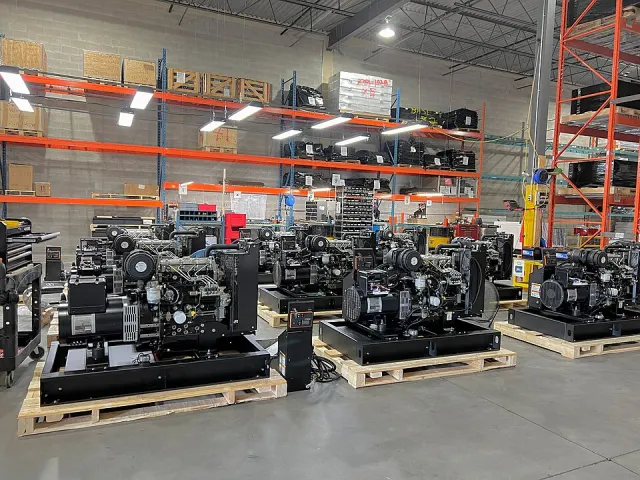
DG sets: standby power bought as one aggregated requirement
Diesel gensets common to hospitals, apartments, factories, commercial buildings.
The range above is an indicative planning figure taken from our own research, not a quotation and not an offer. buytogethr is pre-launch and has closed no pools.
What you are actually buying
An institution buying a DG set is buying an engine and alternator matched to a load profile, and around it an acoustic enclosure, an AMF or changeover panel, a base fuel tank, an exhaust route, a foundation, cabling and commissioning. Quotes diverge on the rating basis, whether it is quoted as prime or standby, the alternator make, the declared sound level at a stated distance, the fuel tank capacity and how much of the civil and electrical work sits inside the scope. The common mistake is sizing from connected load rather than from measured maximum demand with the largest motor start allowed for, which produces a set that runs lightly loaded for its whole life.
Why dg sets suits collective purchasing
DG sets are one of the categories we intend to open first, and the reason is that the specification travels. A kVA band, an enclosure sound rating and an AMF panel describe a hospital, an apartment block, a factory and a college equally well, so a schedule of three or four ratings covers a large group. The buyers are entirely fragmented — each one buys a single set, once, through a local distributor — while the engine side is concentrated in a small number of manufacturers selling through that distribution layer. That shape lets a pooled requirement go to several manufacturers at once, instead of being negotiated one building at a time.
Pin down before price
- kVA rating derived from measured maximum demand, with the largest motor starting step stated
- Prime or standby duty declared, with expected run hours a year
- Enclosure sound level at a stated distance, against the site's acoustic limit
- Battery limits in writing: AMF panel, cabling, exhaust stack, foundation, fuel tank, earthing
- Emission certification held by the set, and who obtains pollution control board consent
What drives ten-year cost
- Fuel burn at the load the set actually carries, over its annual run hours
- The maintenance contract after warranty, and whether oil, filters and coolant are inside it
- Battery, alternator and top-overhaul replacement at stated running hours
- Cost of keeping the set compliant as emission and consent requirements change