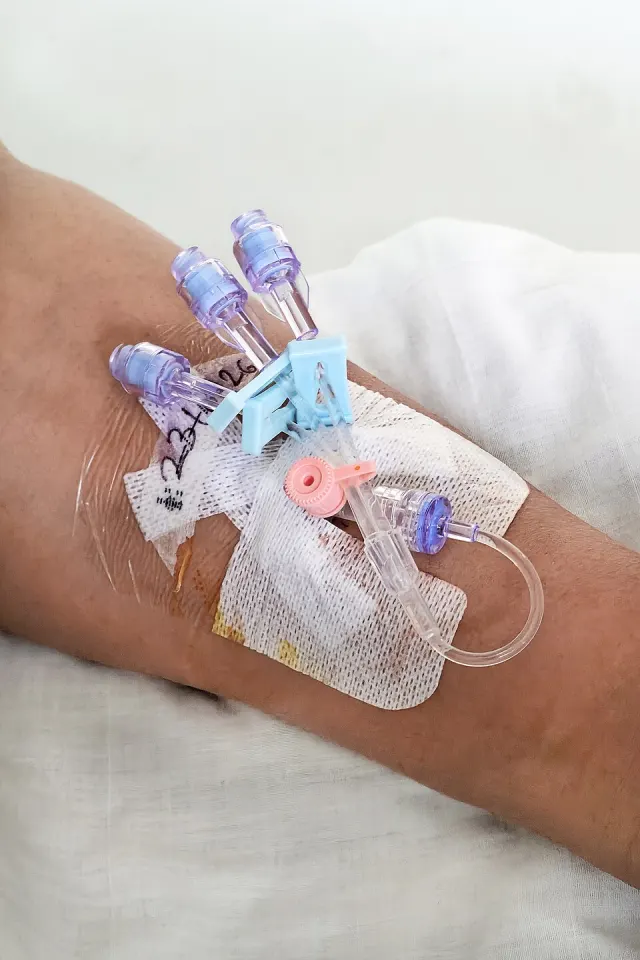
IV cannulas and IV sets: pooling ward and ICU replenishment
Ward and ICU infusion consumables replenished monthly.
The range above is an indicative planning figure taken from our own research, not a quotation and not an offer. buytogethr is pre-launch and has closed no pools.
What you are actually buying
Two families move together. Peripheral cannulas run from 14G to 24G, ported or non-ported, winged or plain, with or without a needle-stick protection mechanism, and the catheter may be PTFE or polyurethane with a radiopaque stripe. Administration sets vary more than their price suggests: vented and non-vented, drip factors of 15, 20 or 60 drops per millilitre, burette sets for paediatrics, blood sets with a filter, extension lines and three-way taps. Quotes differ on catheter material, flashback chamber, safety mechanism, tubing length and DEHP-free declarations. The common error is buying one gauge mix for the whole institution, and specifying sets without saying whether the ward infuses by gravity or the ICU infuses by pump — the two need different sets.
Why iv cannulas and iv sets suits collective purchasing
The written specification standardises well and the volume is steady, so the aggregation arithmetic works. But this is the consumable where nursing acceptance decides whether a contract survives its first month: insertion feel, flashback and the handling of the safety mechanism all matter, and a cannula the ward rejects is expensive at any rate. Run a sample evaluation across the participating institutions before the price stage, then pool what survives it. Administration sets aggregate more easily than cannulas, and where pumps are involved the pump-matched sets should be bid separately against the named models.
Pin down before price
- Gauge mix by department, ported or non-ported, winged or plain
- Safety mechanism type and the standard it is certified against
- Catheter material and radiopacity
- Drip factor, vented or non-vented, and set length for each use
- DEHP-free and latex-free declarations, with pump models named
What drives ten-year cost
- Failed cannulation costs a second set and the nursing time to re-site
- Needle-stick handling where the protection mechanism is poor
- Slow-moving gauges and set types reaching expiry in store