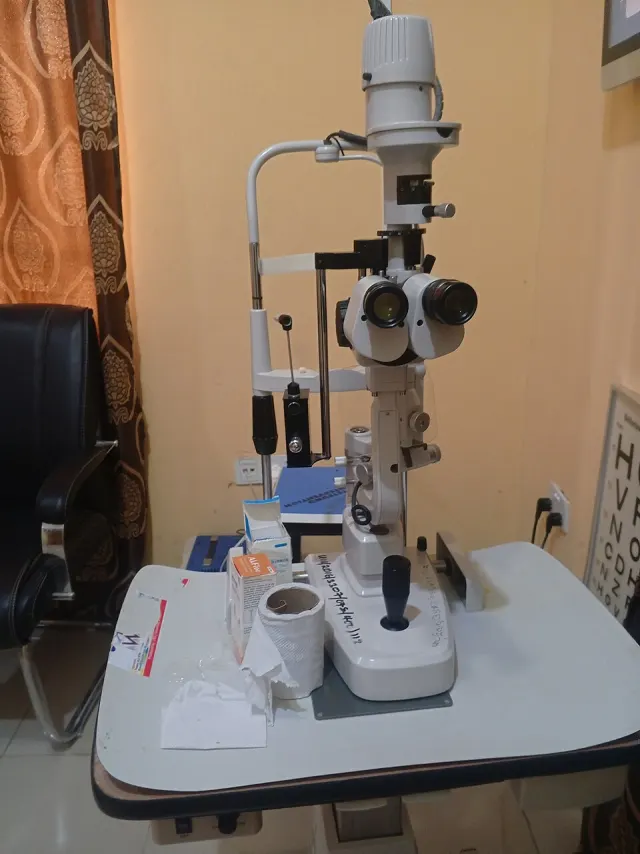
Slit lamp: the eye OPD line that standardises most cleanly
Anterior-segment examination unit for the eye OPD.
The range above is an indicative planning figure taken from our own research, not a quotation and not an offer. buytogethr is pre-launch and has closed no pools.
What you are actually buying
An eye OPD does not buy a slit lamp head; it buys a working examination station. That means the biomicroscope, the illumination tower, the instrument table, the applanation tonometer and its mount, and, where the department teaches or documents, a beam splitter and camera. Quotes diverge on magnification steps and whether they change by drum or turret, on illumination source and the slit dimensions and angles available, on which filters are supplied, and on whether the table is motorised. Two things catch buyers out. Tonometer, table and chair are often priced separately, so like-for-like comparison needs the whole station listed. And imaging usually depends on a particular beam splitter that cannot be added to the head afterwards.
Why slit lamp suits collective purchasing
Of the specialty department lines, this is among the most poolable. The specification is stable, uncontroversial and largely optical, so institutions can agree one without any clinician giving up a preference that matters. Demand is broad and dispersed, since every teaching hospital eye department, mid-size hospital OPD and standalone eye clinic runs more than one, while the supply side is a short list of makers and the distributors they authorise. Pool the complete station as a single specified item and the comparison becomes real, because a supplier can no longer move the difference between the head and the accessories.
Pin down before price
- Magnification steps and changer type, with slit width, length and angle range
- Illumination source and the filters supplied, including cobalt blue and red-free
- Applanation tonometer type and its mount on the specified head
- Table: motorised or fixed, travel, load rating, and the chair if included
- Beam splitter and imaging module, and whether either can be retrofitted
What drives ten-year cost
- Bulb or LED module, mirror and prism replacement, and optics servicing
- Tonometer prism replacement and its disinfection consumables
- Motorised table servicing and periodic tonometer calibration