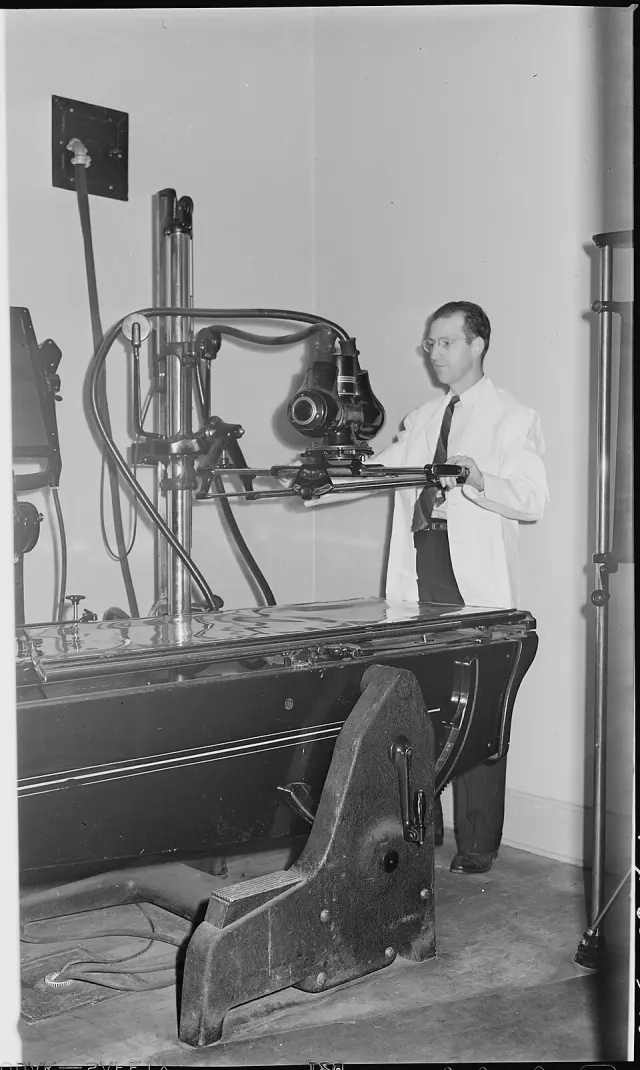
Digital X-ray rooms, specified detector-first before price
Fixed radiography room; AI detection and triage can be retrofitted.
The range above is an indicative planning figure taken from our own research, not a quotation and not an offer. buytogethr is pre-launch and has closed no pools.
What you are actually buying
A fixed radiography room is a generator, tube and stand, table bucky and wall stand, one or more flat-panel detectors, an acquisition console, DICOM worklist and PACS connection, and the lead-lined room around it. Quotes diverge on whether the panel is a true direct-capture detector or an upgrade of an older reader, on panel size, pixel pitch and wired or wireless working, on how many panels are supplied, on generator output, and on whether room works and shielding sit inside the price. The frequent error is buying on generator rating and console features when the detector carries most of the cost and nearly all of the breakage risk, and paying for an AI package at purchase that could be added later as software.
Why digital x-ray suits collective purchasing
This is a strong pooling candidate. A general radiography room standardises far more cleanly than a scanner: the same written specification serves a nursing home, a teaching hospital and a district facility with only the detector count changing. Buyers are numerous and fragmented, and each unit is small enough that no institution buying alone has any leverage, yet large enough that aggregation is worth the effort. Any group of institutions needs several times more radiography rooms than scanners, so pooled volume builds faster here than anywhere else in imaging, and both OEMs and their authorised distributors will bid for it.
Pin down before price
- Detector technology, active area, pixel pitch, wired or wireless, and how many panels are supplied
- Generator output and anode heat capacity matched to the daily film volume the room will actually run
- Tube suspension and positioning: ceiling or floor column, auto-positioning, tube-to-detector tracking
- Detector drop and damage cover, stated explicitly for both warranty and the maintenance contract
- DICOM conformance, worklist integration and the interface an AI detection or triage layer would use later
What drives ten-year cost
- Panel replacement, not tube replacement, usually sets the ten-year figure for a digital room
- Tube life and quoted replacement price at your real workload, not at a nominal duty cycle
- The room itself: shielding integrity, AERB registration and the periodic quality assurance that keeps it licensed