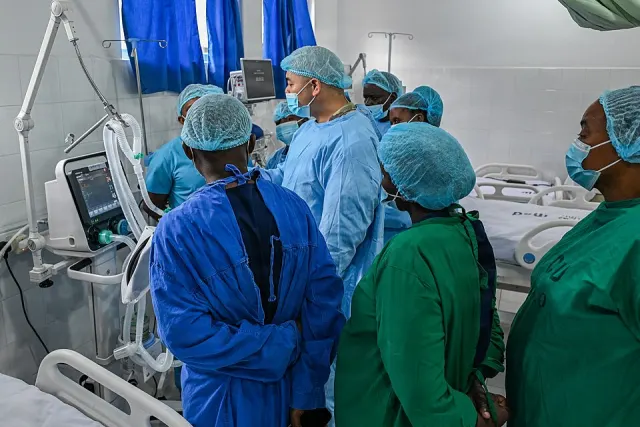
ICU ventilators: one specification, many hospitals, one tender
Invasive and non-invasive ventilation for critical-care beds.
The range above is an indicative planning figure taken from our own research, not a quotation and not an offer. buytogethr is pre-launch and has closed no pools.
What you are actually buying
The institution buys a critical care ventilator for each ventilated bed, with humidification, circuits, a trolley and, where the site has no piped medical air, a compressor. Quotes diverge on the mode set and the proprietary names given to it, on paediatric and neonatal capability, on non-invasive ventilation with leak compensation, on high-flow oxygen, on whether the unit is turbine-driven or gas-driven, on oxygen sensing method, and on battery duration. Two errors recur. Specifying a mode list instead of the patient population actually ventilated buys capability the unit will never use, and treating humidifiers and circuits as accessories hides a running cost that continues for every day the bed is occupied.
Why icu ventilator suits collective purchasing
Ventilators aggregate well. They are bought bed by bed, so a multi-hospital requirement becomes large enough to interest manufacturers directly rather than a local distributor, and the base specification - modes, monitoring, alarms, battery - standardises even where intensivists differ on preferred make. Service weighs more heavily here than for most equipment, because a ventilator out of service takes a critical care bed out of use. Response times, spares holding and an obligation to provide a loan unit belong in the aggregated contract itself, not in a maintenance discussion held two years later when the leverage has gone.
Pin down before price
- Patient population - adult, paediatric, neonatal - and the lowest tidal volume required
- Invasive and non-invasive ventilation, leak compensation and high-flow oxygen
- Gas supply assumption: piped medical air, or an integral turbine or compressor
- Battery duration on internal power and behaviour during intra-hospital transfer
- Monitoring, waveforms and data export to any central station or records system
What drives ten-year cost
- Circuits, filters and humidification consumed per ventilated day
- Oxygen sensor, flow sensor and expiratory valve replacement intervals
- Preventive maintenance and calibration through warranty and the maintenance contract
- Compressor servicing wherever piped medical air is not available